Rambrant Harmenszoon van Rijn, 1666
January, the year I was 20, I spent part of a day’s worth on a tour at the RijksMuseum in Amsterdam, the Netherlands. The tour guide- quirky, woman, and whimsical was my first introduction to Dutch classical painters. I picked her brains at the symbolization of women in nationalist paintings, learned of Dutch colonialism in South and East Asia, and surrendered helplessly to the omnipresence of Catholicism in Classical Art.
RijksMuseum is a fairly-sized Museum, but it isn’t the grandest. My time spent there can easily be divided into a before I was touched by the paintings floor-defying gravity and discovered the mural of wife and husband, lover and beloved – and after. I stared presently in silence at the painting for 45 minutes, until the Museum’s closing.
The Jewish Bride historically has many interpretations, some already disproven. The story our tour guide shared understood the portrait as a biblical reference. The original sketch of the drawing portrays Isaac and Rebekah spied upon by King Abimelech.
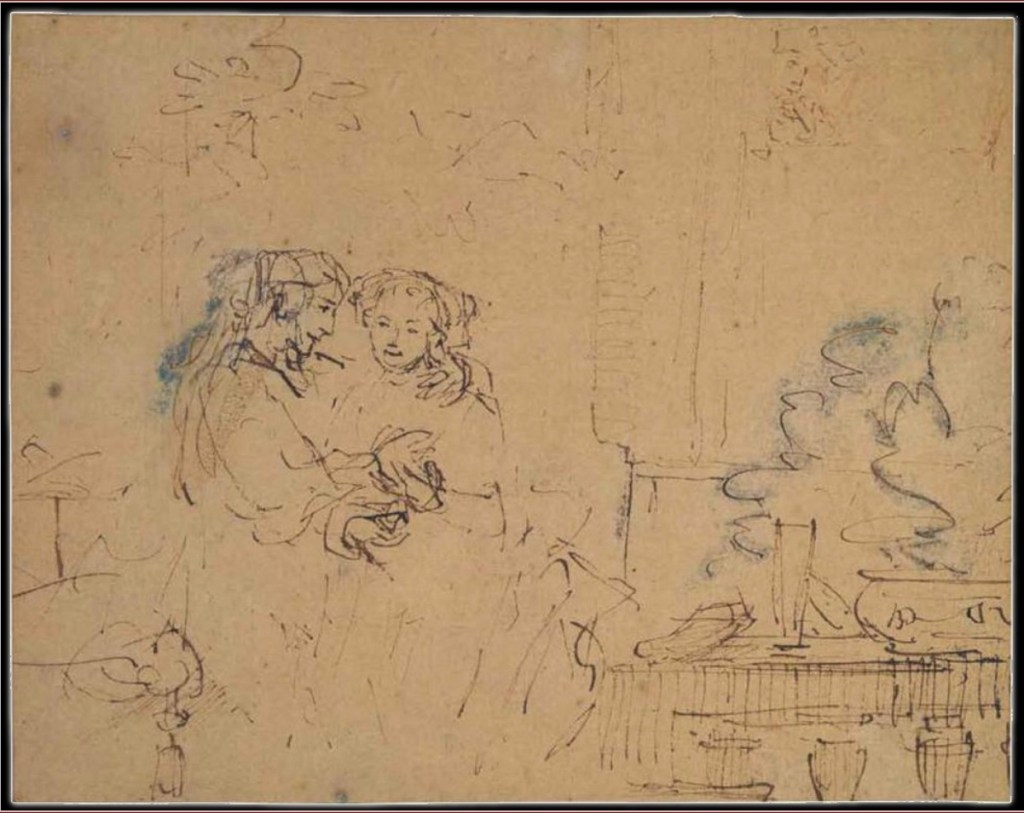
Isaac and Rebekah, fleeing famine sought refuge in the land of King Abimelech of the Philistines. Fearful of the fatal consequences of being discovered as married lovers, they posed as siblings. The portrait captures the zenith moment in which King Abimelech discovers their misconduct (you can loosely identify him in the top right corner of the sketch) alongside the couple’s inner desires to unmask their love and attraction.
The magic of this mural does not lie in the tale of Rebekah and Isaac. Before I learned of its origins, my heart calmed from merely glancing its shaded edges and dark features.
I was stricken by the harmonious stage of Rebekah’s brilliant red hues, sowed along her gown to her warm glowing cheeks, molding into Isaac’s complimentary colors. The color contrasts lead the observer’s gaze to the center of the mural, to the heart of it; Rebekah’s heart being held in the intimacy of Isaac’s hand. He holds her as though she were a thing of fiction, fleeting and yet his all the same. Rebekah avoids his gaze showing a fear greater in herself than in her husband. If we consider the way they are both positioned, their profiles are closer to the viewers than they are to each other. We are allowed to observe them in their shame and fear, and are forced into silence, as they still choose each other within the murky judgement.

This portrait is a romantic’s starlet; the closest of its age to conceptually capture love. The Jewish Bride is tender, intimate, and incredibly melancholic.
It was Van Gogh who said,
“I should be happy to give 10 years of my life if I could go on sitting here in front of this picture for a fortnight, with only a crust of dry bread for food.“
And I get it, I really do.
This is a painting to inspire a museum, and the sympathetic women wandering within them.
 angelina
Leave a comment